BMW X5 E53 (2000–2006)
Generation-specific owner insights from 119+ substantive owner discussions, with US complaint and recall records.
Should I buy a 2000–2006 X5?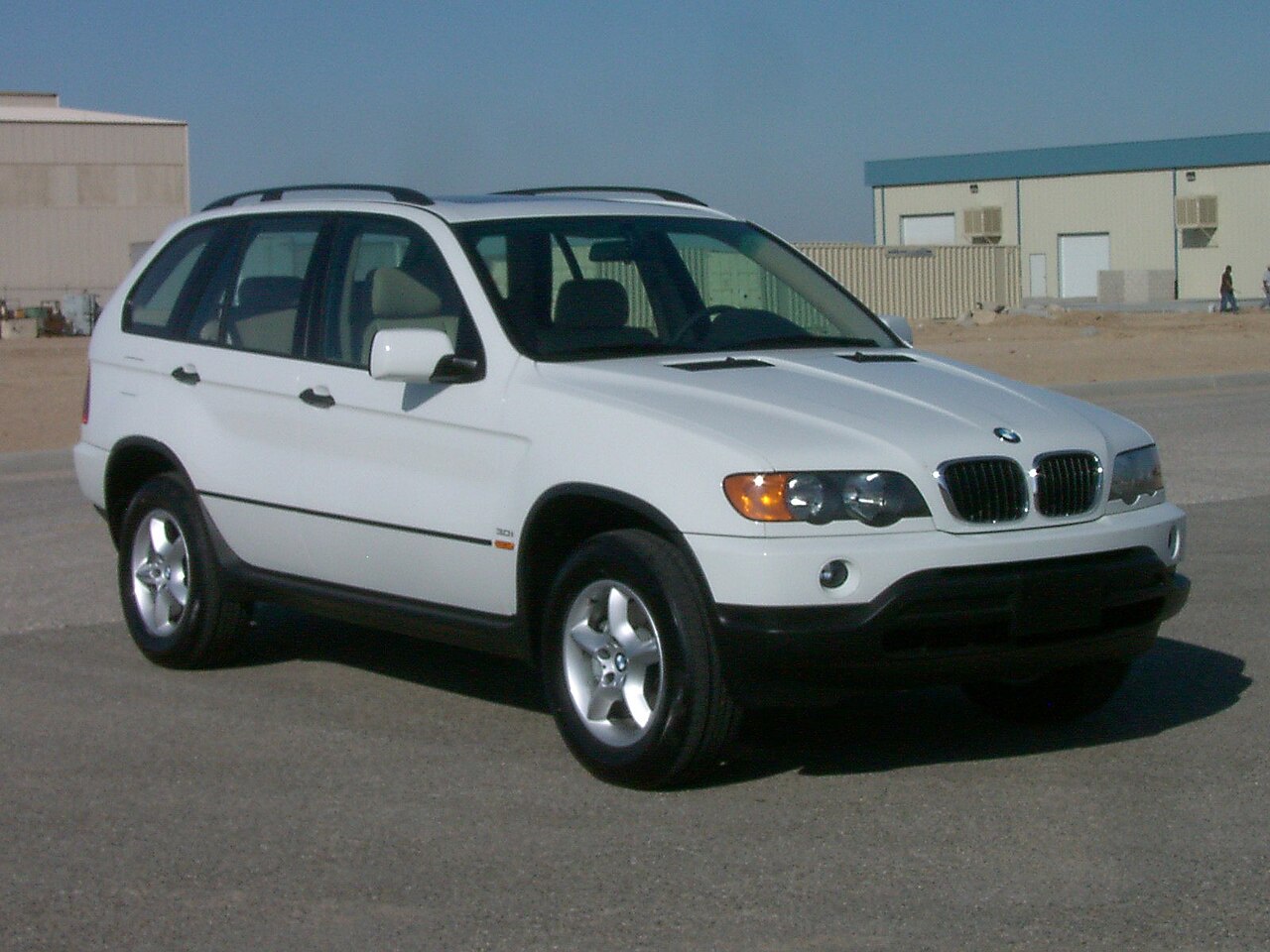

946
US owner complaints (NHTSA), 2000–2006
34
recall campaigns
air bags
most-complained area
What owners say about this generation
Our take, from owner reports
Owners describe the E53 X5 as a genuinely enjoyable vehicle to drive, with strong power, good handling for an SUV, and a well-kept interior that has aged well, but the dominant sentiment is that it is expensive and demanding to own.
22 problems reported (4 very frequent, 11 recurrent, 7 isolated) · high confidence
Problems owners report
- Very frequentOil pan and valve cover gasket leaks
- Very frequentCooling system problems
Including radiator, water pump, coolant valley pipe, and full system overhauls around 100,000 miles.
- Very frequentTiming chain guide failure on V8 cars
Often around 100,000-130,000 miles with potential engine destruction.
+ 19 more issuesShow fewer
- Very frequentValve stem seal failure on N62 V8 cars, requiring expensive repair
- RecurrentTiming case cover gaskets on V8 cars
- RecurrentWater-cooled alternator failure on V8 cars, described as expensive
- RecurrentAir suspension problems
- RecurrentFront suspension and control arm wear, with some owners reporting something broken every six months
- RecurrentDoor handles breaking or flaking, and window regulator failure
- RecurrentSecondary air injection system clogging
- RecurrentVANOS issues on the M54
- RecurrentTransmission issues
Including failure around 190,000 miles and mechatronic damage from skipped fluid services.
- RecurrentBurning oil consumption on V8 cars
- RecurrentSqueaky body bushings and general fit-and-finish problems
- RecurrentPower steering leaks
- IsolatedFront differential driveshaft routed through the sump, making access difficult
- IsolatedWindshield washer bottle leaks
- IsolatedShort front driveshaft issue
- IsolatedDash LCD pixel failure
- IsolatedCV joint failure
- IsolatedStarter failure at high mileage
- IsolatedAux input absent from the factory radio, requiring an add-on part
The version owners recommend
The 3.0i with the M54 straight six is the consensus pick within this generation. Owners repeatedly call the M54 solid and reliable, cite examples running past 200,000 and even 300,000 miles, and describe the six-cylinder X5 as "actually pretty solid." The V8s are consistently discouraged: the N62 (2004-2006) is called out for valve stem seals, timing chain guides, and timing case covers, and the M62 (2000-2003) is described as having mainly the timing chain guide issue and being the more reliable of the two V8s. Among V8s, the 4.6is and 4.8is are praised for sound and power but come with the strongest reliability warnings.
Competitors to consider
Owners compare it most often with the Subaru Outback, Subaru Forester, Toyota RAV4, Toyota 4Runner and Toyota Highlander.
Is a 2000–2006 X5 right for you?
Get an answer for your year, mileage and budget.
Full owner reportHide full owner report
Overall sentiment
Owners describe the E53 X5 as a genuinely enjoyable vehicle to drive, with strong power, good handling for an SUV, and a well-kept interior that has aged well, but the dominant sentiment is that it is expensive and demanding to own. The most repeated framing is that the low purchase price is misleading because maintenance and repair costs are high and frequent, and several owners say it is the most unreliable vehicle they have owned. The straight-six cars (3.0i, M54) draw noticeably warmer sentiment than the V8 cars, which are repeatedly described as notorious for expensive engine work. Early cars with the M62 V8 (roughly 2000-2003) are treated as somewhat less troublesome than the later N62 V8 (roughly 2004-2006), which owners single out for valve stem seals, timing chain guides, and timing case cover work.
Positioning vs competitors
Owners consistently position the E53 as the more rewarding but more expensive choice: it drives and feels better than the Japanese and domestic SUVs they cross-shopped, but it costs far more to maintain and is far less reliable. Against the Subaru Outback and Forester, owners say the X5 has more power and a nicer interior but is the opposite of a Subaru on repair costs, reliability, and fuel economy. Against the Nissan Murano and Pathfinder, owners argue the X5 mainly "nickel and dimes" with expensive parts, whereas the Nissans have specific catastrophic failures (CVT/transfer case on the Murano, radiator-to-transmission coolant mixing on the Pathfinder). Against the Mazda CX-9, owners split, with some saying the Mazda has a lower cost of ownership and others saying the X5 six-cylinder is the more solid car. Against newer BMW X5 generations, owners repeatedly say the E53 is a DIY hobby car and that later generations are more reliable, while still preferring the E53's looks and driving feel.
Recommended configurations
Owners recommend the 3.0i / M54 straight-six over any V8, and within the V8 range they prefer the pre-facelift M62 (2000-2003) over the later N62 (2004-2006) if a V8 is unavoidable. Owners advise factoring in a maintenance reserve of roughly 2,000 to 5,000 dollars on top of the purchase price, budgeting 3,000 to 5,000 dollars specifically for timing chain guide work on V8 cars around 100,000-130,000 miles, and doing valve stem seals, oil cooler seal, coolant valley pan, and rear subframe bushings as a package on V8 cars. Owners also advise servicing the transmission every 50,000-70,000 miles and changing oil at no more than 7,000-mile intervals rather than the factory-recommended longer interval.
General recommendations
This generation suits owners who do their own work, have a garage and tools, and accept ongoing maintenance as a hobby rather than a cost-saving purchase; owners explicitly say it is a good DIY hobby car and a bad choice for anyone on a tight budget or expecting cheap ownership. Buyers are advised to get a pre-purchase inspection from an independent German-car specialist, check for oil pan and valve cover gasket leaks, coolant system condition, timing chain guides on V8s, air suspension, and front suspension wear, and to prefer documented service history over low mileage, since low mileage does not mean aged gaskets and plastic hoses are still good. Owners warn that a 5,000-dollar budget is not enough for this car once repairs are included, and several advise spending more on a different model instead.
Remarks
Owners note that the E53 was built at BMW's South Carolina plant, which was new at the time and drew criticism for a plasticky interior feel compared to other BMW models, though some owners say build quality improved after the first few years. Several owners mention that the 3.0 did not use the water-cooled alternator found on the V8 cars. Owners also note the rear seats recline electrically on some cars, and that Bluetooth, when present, handles calls only and not audio streaming. A recurring theme is that the car is enjoyable enough that owners tolerate the repair burden, with one owner describing it as almost designed to fail but still worth restoring. Analysis based on approximately 119 substantive owner discussions about this generation.
Complaints and recalls by model year
| Year | Complaints | Recalls | Most-reported area |
|---|---|---|---|
| 2006 | 280 | 2 | air bags |
| 2005 | 103 | 3 | air bags |
| 2004 | 127 | 4 | air bags |
| 2003 | 115 | 4 | engine and engine cooling |
| 2002 | 116 | 3 | engine and engine cooling |
| 2001 | 176 | 12 | engine and engine cooling |
| 2000 | 29 | 6 | visibility |
Source: US National Highway Traffic Safety Administration. Higher-selling years naturally accumulate more complaints.
Recall notices for this generation
2006 · air bags:sensor:occupant classificationcampaign 13V564000
BMW of North America LLC (BMW) is recalling certain model year 2006 325i, 325xi, 330i, 330xi sedans and 325xi sports wagons, model year 2007 328i, 328xi, 335i, 335xi sedans and 328i and 328xi sports wagons, model year 2006-2007 525i, 525xi, 530i, 530xi, 550i sedans and 530xi sports wagons, model year 2006 760i sedans, model year 2006-2007 750i, 750Li, and 760Li sedans, and model year 2006 X5 sports activity vehicles, equipped with certain seat types. The front passenger seat occupant detection mat that determines if and how the passenger frontal air bag should deploy in a crash may fatigue and develop cracks which could lead to a system failure.
2006 · power train:automatic transmissioncampaign 05V504000
CERTAIN PASSENGER VEHICLES MAY HAVE BEEN BUILT WITH AN INCORRECTLY MANUFACTURED AUTOMATIC TRANSMISSION PARKING PAWL GUIDE PLATE.
2005 · service brakes, hydraulic:foundation components:hoses, lines/piping, and fittingscampaign 05V367000
ON CERTAIN SPORT UTILITY VEHICLES, THE ATTACHMENT OF THE BRAKE LINE SUPPORT BRACKET WITHIN THE FRONT LEFT WHEEL WELL WAS NOT WELDED ACCORDING TO SPECIFICATIONS. IT COULD LOOSEN AND OVER TIME THE BRAKE HOSE COULD RUB AGAINST THE WHEEL WELL.
2005 · power train:automatic transmissioncampaign 05V504000
CERTAIN PASSENGER VEHICLES MAY HAVE BEEN BUILT WITH AN INCORRECTLY MANUFACTURED AUTOMATIC TRANSMISSION PARKING PAWL GUIDE PLATE.
2005 · equipmentcampaign 07E069000
CERTAIN AFTERMARKET BMW BIKE CARRIERS, P/N 82110393954, SOLD FOR USE ON MY 2005 BMW X3 AND X5 VEHICLES. A PINCH BOLT EXISTS BETWEEN THE BIKE ARM BRACKET AND THE UPRIGHT ASSEMBLY OF THE HITCH STYLE BICYCLE RACK.
2004 · power train:driveline:differential unitcampaign 03V475000
ON CERTAIN SPORT UTILITY VEHICLES, THE BOLTS THAT HOLD THE FRONT DIFFERENTIAL, THE RIGHT OUTPUT SHAFT HOUSING FLANGE AT THE ENGINE, AND THE RIGHT-HAND ENGINE SUPPORT MAY BE INSUFFICIENTLY TIGHTENED.
2004 · power train:automatic transmission:control module (tcm/pcm/tecm)campaign 04V344000
ON CERTAIN PASSENGER VEHICLES EQUIPPED WITH 8 AND 12 CYLINDER ENGINES, THE DIGITAL ENGINE MANAGEMENT CONTROL (EMC) UNITS WERE NOT PRODUCED ACCORDING TO SPECIFICATIONS.
2004 · power train:clutch assembly:pedal/hand lever(motorcycle)campaign 04V409000
ON CERTAIN PASSENGER VEHICLES WITH 3.0 L ENGINES AND MANUAL TRANSMISSIONS, IF THE VEHICLE IS IN FIRST GEAR, AND MOVING SLOWLY, WITH THE ACCELERATOR PEDAL HELD IN A CONSTANT POSITION OF LOW ENGINE SPEED AND WITH THE CLUTCH PEDAL HELD IN A PARTIALLY DEPRESSED POSITION, ENGINE SPEED MAY INCREASE.
2004 · fuel system, gasoline:delivery:fuel pumpcampaign 04V402000
ON CERTAIN SPORT UTILITY VEHICLES, THE IN-TANK FUEL LINE MAY HAVE BEEN ATTACHED INCORRECTLY.
2003 · air bags:frontal:driver side:inflator modulecampaign 17V047000
BMW of North America, LLC (BMW) is recalling certain 2000-2002 BMW 320i, 323i, 325i, 325xi, 330i, 330xi, 323Ci, 325Ci, 330Ci, M3, 323iT, 325iT and 325xiT vehicles, 2001-2002 525i, 530i, 540i, M5, 525iT and 540iT vehicles, and 2001-2003 X5 3.0i, X5 4.4i, and X5 4.6is vehicles. These vehicles may have had a driver-side air bag module installed as replacement equipment such as after a vehicle crash necessitating replacement of the original air bag, or as a remedy part for a prior recall. These replacement modules contain an air bag inflator that may rupture due to propellant degradation occurring after long-term exposure to lower absolute humidity, temperature and temperature cycling.
2003 · air bags:frontal:driver side:inflator modulecampaign 15V318000
BMW of North America, LLC (BMW) is recalling certain model year 2002-2005 325i, 325xi, 330i, and 330xi Sedans, and 325xi and 325i Sportswagons, 2002-2006 330Ci, 325Ci, and M3 Convertibles and 325i, 330i, and M3 Coupes, 2002-2003 M5, 540i, 525i Sedan, and 530i Sedans, and 540i and 525i Sportswagons, and 2003 X5 3.0i and 4.4i Sports Activity Vehicles. Please note that the 5-series and X5 vehicles are only included if they are equipped with the optional sports steering wheel. The affected vehicles are equipped with a dual-stage driver frontal air bag that may be susceptible to moisture intrusion which, over time, could cause the inflator to rupture.
2003 · service brakes, hydraulic:foundation components:hoses, lines/piping, and fittingscampaign 03V197000
ON CERTAIN PASSENGER VEHICLES, IT IS POSSIBLE THAT THE DISTANCE BETWEEN THE BRAKE LINE AND THE STEERING SHAFT JOINT IS NOT SUFFICIENT. IF THIS OCCURS, THE BRAKE LINE COULD COME INTO CONTACT WITH THE JOINT AND EVENTUALLY SUFFER DAMAGE AND CORROSION.
15 more recalls not shown. Check nhtsa.gov with your VIN for the full history.
Owner insights summarize real ownership discussions for this generation only. Complaint and recall data is public NHTSA (US) information. Always verify recalls against your VIN at nhtsa.gov.