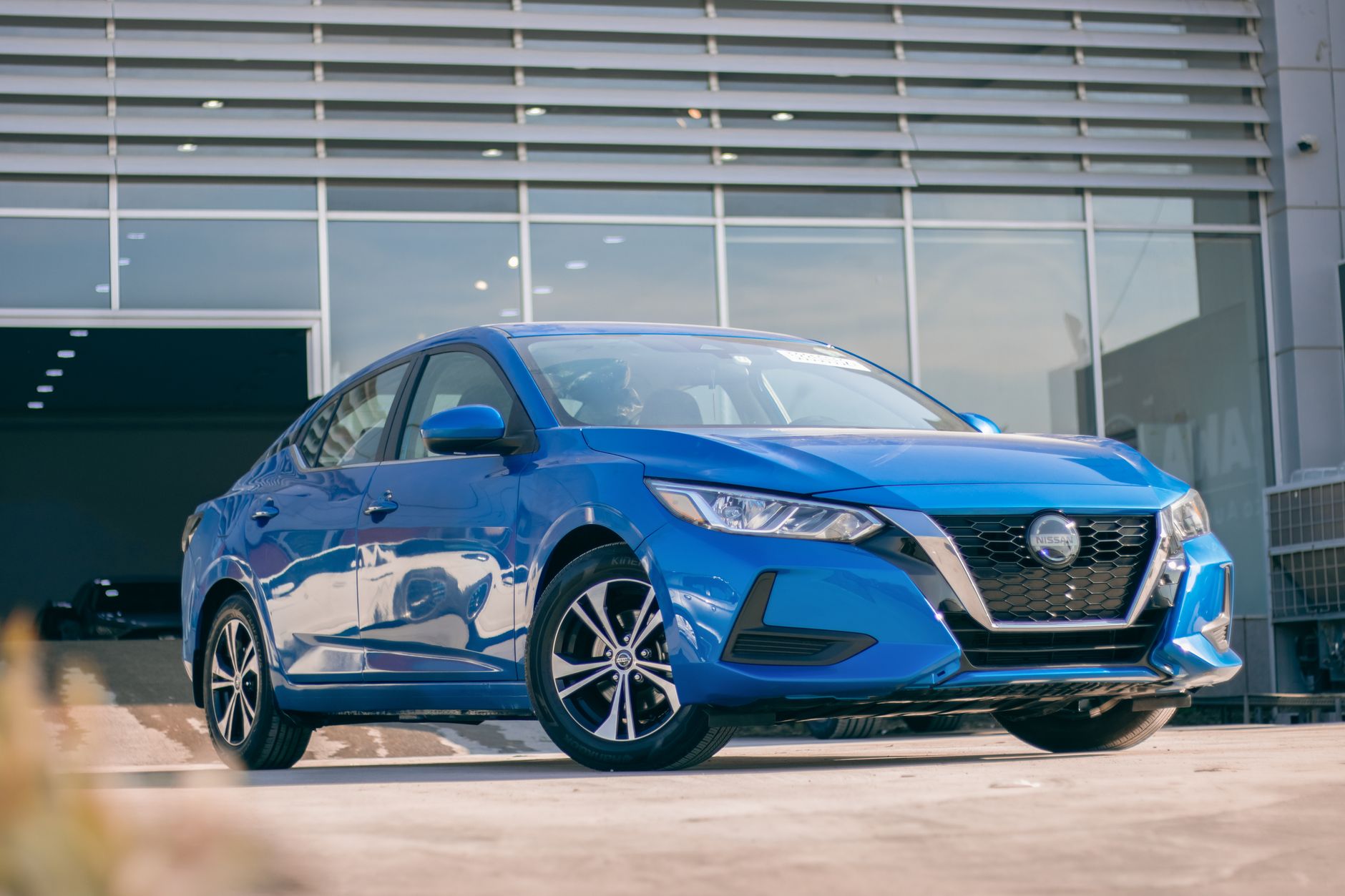
Photo: User3204 / CC BY 4.0 / Wikimedia Commons
Nissan Altima
Sedan · Gas · 22 versions · owner report
Ranked #4 of 6 midsize cars on owner data, price and fuel economy
Every generation
Power
0–62 mph (0–100 km/h)
Top speed (235 km/h)
Combined, EPA 2026
What owners say
Our take, from owner reports
Extremely negative sentiment regarding long-term reliability, dominated by widespread and severe criticism of the Continuously Variable Transmission (CVT).
5 problems reported (2 very frequent, 2 recurrent, 1 isolated) · high confidence
Problems owners report
- Very frequentCVT transmission failure
Catastrophic failure requiring full replacement, often between 80,000-150,000 miles; symptoms include jerking, shuddering, loss of acceleration, lurching at low speeds, and inability to rev beyond a certain RPM. Associated with multiple class-action lawsuits, especially for 2010-2020 models.
- Very frequentCVT-related problems (general)
Whining noise, rubber band effect, laggy throttle response, and general concerns about long-term durability.
- RecurrentEngine issues (various)
For 2019-2021 models with the 2.0L VC-Turbo engine, a manufacturing defect in engine bearings can lead to catastrophic engine failure, knocking noises, loss of power, and potential fire, as detailed in a NHTSA recall (25V437). For older 2.5L engines, reports of oil consumption, misfires, and sensor problems.
+ 2 more issuesShow fewer
- RecurrentElectrical and sensor problems
Faulty camshaft/crankshaft position sensors causing stalling and erratic idle; alternator failures; flickering dashboard lights; stereo/infotainment malfunctions (volume changing randomly, resets).
- IsolatedBuild quality and interior issues
Noted decline in interior material quality over successive generations; components becoming loose or rattling; general perception of cheapening.
The version owners recommend
Insufficient owner data available to identify a consensus "best" model year or trim. Isolated positive anecdotes reference older models (e.g., 2002 Maxima, pre-2010 Altimas) with traditional automatic transmissions, but no specific Altima generation or trim receives repeated endorsement. The data strongly suggests avoiding any model year equipped with the problematic CVT, which encompasses most vehicles from approximately 2010 onward.
Competitors to consider
Owners compare it most often with the Honda Civic, Honda Accord, Toyota Camry, Toyota Corolla and Mazda3.
Is the Altima right for you?
Get an answer for your year, mileage and budget.
Full owner reportHide full owner report
Overall sentiment
Extremely negative sentiment regarding long-term reliability, dominated by widespread and severe criticism of the Continuously Variable Transmission (CVT). The CVT is described as a fundamental design flaw leading to premature failure, often between 80,000 and 150,000 miles, with replacement costs cited around $4,000. This issue is so pervasive it has spawned multiple class-action lawsuits, particularly for models from the 2010-2020 period. Positive feedback is isolated and primarily centers on the vehicle's initial comfort, quietness, and affordability when purchased new or lightly used. However, the overwhelming consensus from long-term owner reports is that the Altima is not a vehicle known for longevity, with many describing it as a "clunker" that becomes a significant financial liability after the initial ownership period. Sentiment is slightly more mixed for very early models (pre-2010) and for owners who claim rigorous, specific maintenance, but the dominant narrative is one of inherent mechanical unreliability.
Positioning vs competitors
Positioned as a more affordable but significantly less reliable alternative to segment leaders. Frequently and unfavorably compared to the Honda Accord and Toyota Camry, which are cited as having superior longevity, routinely reaching 200,000+ miles. The Altima is acknowledged to offer competitive initial comfort, features, and driving dynamics for the price, but is universally characterized as a poor long-term investment. It is considered inferior to mainstream competitors from Honda and Toyota in terms of reliability and resale value. Comparisons to the Chevrolet Malibu are made, with the Altima sometimes seen as marginally better or equivalent, but both are viewed as less reliable than Japanese market leaders.
Recommended configurations
Insufficient owner data available on preferred configurations. The only strong, recurrent recommendation is to avoid the CVT transmission entirely. For those who proceed with a CVT-equipped model, there is a recurrent, specific maintenance recommendation: use only genuine Nissan NS-2 CVT fluid and change it every 25,000-60,000 miles (more frequently for severe driving conditions), contrary to past "lifetime fluid" claims from the manufacturer. An extended warranty is strongly implied as necessary.
General recommendations
NOT recommended for buyers seeking a long-term, reliable vehicle. Considered suitable only for those with a very short-term ownership plan, who prioritize low initial purchase price over total cost of ownership, and who are prepared for a high likelihood of major transmission repair. A pre-purchase inspection is considered essential. For any other buyer, the overwhelming advice is to choose a Honda or Toyota competitor instead. If purchasing a used Altima with a CVT, budget immediately for a transmission replacement and secure an extended warranty that explicitly covers the CVT. Negotiate the purchase price aggressively to account for this known future expense.
Remarks
The negative reputation is heavily concentrated on CVT reliability, with owner discussions indicating the issue was most severe for the 2010-2020 model years. A significant contributing factor cited is Nissan's initial "lifetime fluid" recommendation for the CVT, which owners believe led to neglect and accelerated failures. Proponents argue that with strict, frequent fluid changes using OEM fluid, the CVTs can last longer, but this is presented as a mitigating practice, not a solution to a flawed design. The perception of unreliability is so entrenched it is described as a cultural "echo chamber" or "groupthink," though the volume of firsthand failure reports in the data substantiates the concern. Analysis based on owner experiences spanning model years 2005 to 2025.
Generation by generation
Owner insights per generation and US complaint/recall records (NHTSA).
Complaints and recalls by model yearWorst year: 2013. Years to avoid: 2015, 2014, 2013, 2009, 2008, 2003, 2002Source: NHTSA (US)Show table
Each year graded against the model's other years: Year Score. See all Nissan Altima years to avoid
| Year | Complaints | Recalls | Most-reported area |
|---|---|---|---|
| 2026 | 1 | 0 | electrical system |
| 2025 | 7 | 2 | service brakes |
| 2024 | 41 | 1 | unknown or other |
| 2023 | 29 | 0 | electrical system |
| 2022 | 20 | 0 | forward collision avoidance |
| 2021 | 70 | 2 | forward collision avoidance |
| 2020 | 179 | 6 | electrical system |
| 2019 | 232 | 7 | electrical system |
| 2018 | 226 | 2 | unknown or other |
| 2017 | 391 | 3 | power train |
| 2016 | 553 | 4 | power train |
| 2015 | 954 | 10 | exterior lighting |
| 2014 | 1,113 | 8 | exterior lighting |
| 2013 | 2,312 | 12 | air bags |
Complaint counts come from owner reports filed with the US National Highway Traffic Safety Administration. Higher-selling years naturally accumulate more complaints.
Recall notices126 on record · Source: NHTSA (US)Show recalls
2025 · latches/locks/linkages:doors:latchcampaign 26V023000
Nissan North America, Inc. (Nissan) is recalling certain 2025 Altima, Sentra, 2025-2026 Frontier, and 2026 Kicks vehicles. The door strikers may have been improperly welded and break, allowing the door to open while moving. As such, these vehicles fail to comply with the requirements of Federal Motor Vehicle Safety Standard number 206, "Door Locks and Door Retention Components."
2025 · air bags:critical fastenerscampaign 26V526000
Nissan North America, Inc. (Nissan) is recalling certain 2025 Altima vehicles. The front passenger air bag and front passenger knee air bag may have been installed with incorrect mounting fasteners, which can cause the air bags not to deploy as intended.
2024 · steering:rack and pinioncampaign 23V882000
Nissan North America, Inc. (Nissan) is recalling certain 2024 Altima vehicles. The bolts connecting the electronic power steering unit to the steering rack may loosen, resulting in a loss of steering control or steering lock-up.
2021 · steering:linkages:tie rod assemblycampaign 21V138000
Nissan North America, Inc. (Nissan) is recalling certain 2020-2021 Nissan Altima vehicles. The tie rod ball joint fastener was not tightened properly, which could result in the tie rod ball joint detaching from the steering knuckle.
2021 · back over prevention: sensing system: cameracampaign 23V628000
Nissan North America, Inc. (Nissan) is recalling certain 2019-2021 Altima and 2020-2021 Sentra vehicles. Damage to the camera harness can cause distortion or loss of the rearview camera display image. As such, these vehicles fail to comply with the requirements of Federal Motor Vehicle Safety Standard number 111, "Rear Visibility."
2020 · steering:linkages:tie rod assemblycampaign 21V138000
Nissan North America, Inc. (Nissan) is recalling certain 2020-2021 Nissan Altima vehicles. The tie rod ball joint fastener was not tightened properly, which could result in the tie rod ball joint detaching from the steering knuckle.
2020 · tirescampaign 21V169000
Nissan North America, Inc. (Nissan) is recalling certain 2019-2020 Altima and 2018-2021 Titan vehicles equipped with Continental tires. On the affected vehicles, it is possible that one or more tires were cured for too long during tire production.
2020 · visibility:glass, side/rearcampaign 20V570000
Nissan North America, Inc. (Nissan) is recalling certain 2020 Altima, Maxima and Leaf vehicles. The rear window glass may not remain properly secured to the vehicle.
2020 · tirescampaign 20V685000
Nissan North America, Inc. (Nissan) is recalling certain 2020 Altima S grade vehicles equipped with Continental ProContact TX tires, size 215/60 R16 H, with TIN date code 3320 and Mold ID S-419149. The tires may have been over cured.
2020 · back over prevention: sensing system: cameracampaign 23V628000
Nissan North America, Inc. (Nissan) is recalling certain 2019-2021 Altima and 2020-2021 Sentra vehicles. Damage to the camera harness can cause distortion or loss of the rearview camera display image. As such, these vehicles fail to comply with the requirements of Federal Motor Vehicle Safety Standard number 111, "Rear Visibility."
2020 · engine and engine cooling:engine:hard parts internal/mechanicalcampaign 25V437000
Nissan North America, Inc. (Nissan) is recalling certain 2021-2024 Rogue, 2019-2020 Altima, 2019-2022 Infiniti QX50, and 2022 Infiniti QX55 vehicles equipped with 3-cylinder 1.5L or 4-cylinder 2.0L variable compression turbo (VC-Turbo) engines. The engine bearings may have manufacturing defects that can lead to engine failure.
2019 · tirescampaign 21V169000
Nissan North America, Inc. (Nissan) is recalling certain 2019-2020 Altima and 2018-2021 Titan vehicles equipped with Continental tires. On the affected vehicles, it is possible that one or more tires were cured for too long during tire production.
2019 · fuel system, gasoline:delivery:fuel pumpcampaign 19V316000
Nissan North America, Inc. (Nissan) is recalling certain 2019 Altima vehicles equipped with front wheel drive (FWD) and 2.5 liter engines. The fuel pump lock ring may not be fully engaged, possibly causing fuel to leak. As such, these vehicles fail to comply with the requirements of Federal Motor Vehicle Safety Standard (FMVSS) number 301, "Fuel System Integrity."
2019 · fuel system, gasoline:delivery:fuel pumpcampaign 18V922000
Nissan North America, Inc (Nissan) is recalling certain 2019 Altima vehicles. The retainer clip connecting the low pressure fuel tube to the high pressure fuel pump may not have been locked into position.
2019 · exterior lighting:brake lights:switchcampaign 19V235000
Nissan North America, Inc. (Nissan) is recalling certain 2019 Nissan Altima vehicles. The brake switch bracket may be in the incorrect location, which may cause the brake switch to remain on.
111 older recalls not shown. Check nhtsa.gov with your VIN for the full history.
Specifications
2.5 DIG Xtronic
2.5L 4-cylinder · 188 hp · FWD · automatic
Built 2022–2026